
Last updated:
The standard Bushnell Tour V6 is a laser rangefinder for measuring a target you acquire through its optics. Keep it separate from the Tour V6 Shift, whose slope function changes the comparison. Before deciding on either, demonstrate the eyepiece and target feedback yourself. The useful purchase is a rangefinder you can aim and read confidently in the situations where you want a distance.
Link disclosure: The manufacturer and support links in this guide are direct information sources. No commission is assumed from them.
Guide checked: 8 September 2026. This article uses the linked manufacturer documentation. We have not carried out hands-on product testing. Check the exact model and current buying terms before ordering.
| Question | What to check | Why it matters |
|---|---|---|
| Model | Tour V6 versus Tour V6 Shift | Do not transfer slope features between versions |
| Target acquisition | Flag and background distinguished | A plausible number can describe the wrong object |
| Power | 3V CR2 specification for standard V6 | Buy the correct spare for the exact model |
| Offer | Condition, case, accessories and UK supplier | A foreign specification page is not a local stock check |
Table of Contents
Start with standard V6 versus Shift
The standard Tour V6 specification lists 6x magnification, an LCD and a 3V CR2 power source. Bushnell also describes visual and vibration feedback when acquiring a flag. The separately documented Tour V6 Shift adds slope controls. Compare the full model names, especially where a retailer groups the versions under one page or uses photographs of both.
Ask which function you actually want. If your task is measuring an ordinary line-of-sight distance, evaluate that directly. If you have a permitted use for adjusted distances, understand the Shift controls before paying for them. The standard model should not be described as supplying slope merely because a closely named version does.
Read Bushnell’s standard Tour V6 specifications
Read the separate Tour V6 Shift support information
Demonstrate target acquisition at realistic distances
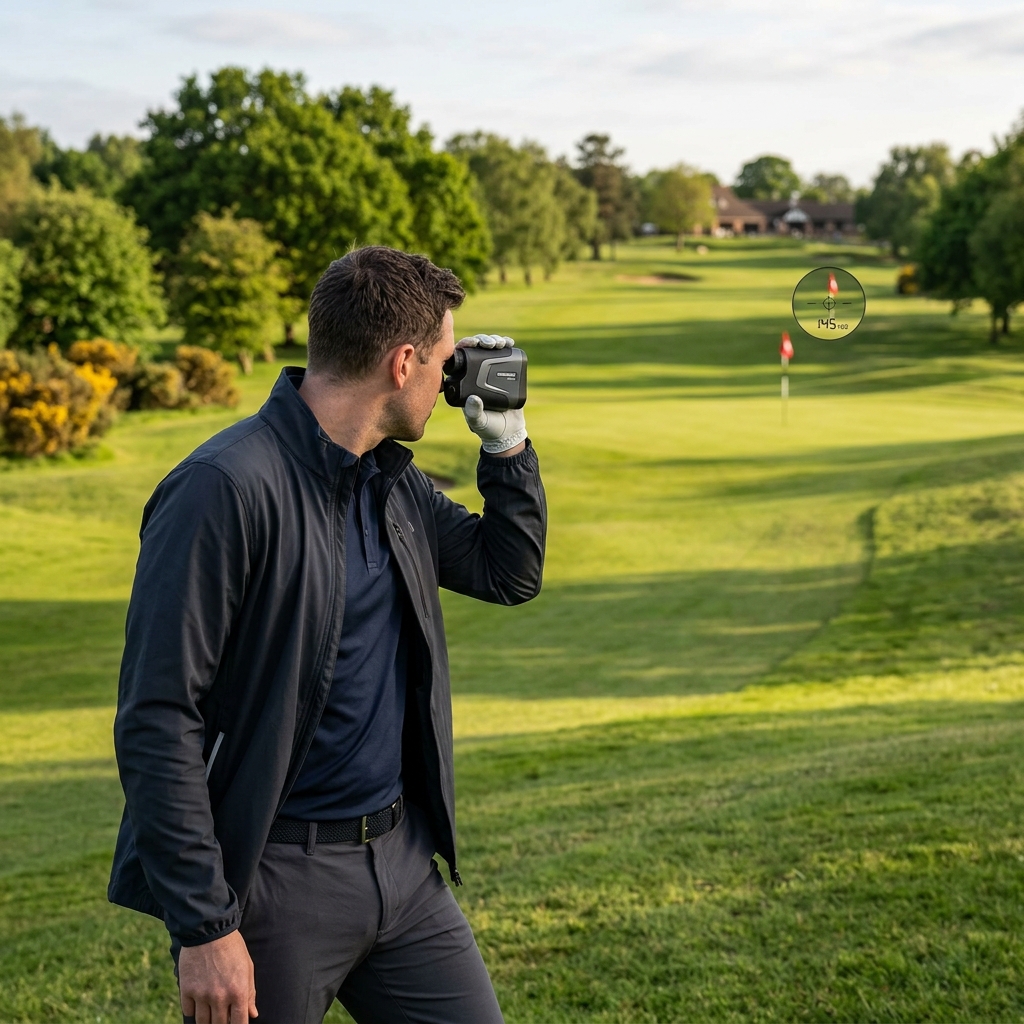
Try acquiring a flag with visible background detail, then check whether you understand the feedback and displayed number. A large maximum-range figure is less useful than comfortable operation on the shots you face regularly. Include the glasses you use if relevant, and adjust the eyepiece according to the instructions rather than judging the display from one hurried look.
Repeat an uncertain reading and compare the intended target with the surroundings. A laser measures what it acquires; it does not know which object you meant to select. If the number looks implausible, check the target and mode before using it for club selection. Feedback can be helpful without being a guarantee against every aiming mistake.
Relate the number to the landing area
A flag distance supplies one point in the shot. Consider the space before and beyond it and any obstacle that changes the minimum carry requirement. You may choose a target away from the flag after understanding those boundaries. The rangefinder should improve the information available for that decision rather than encourage aiming at every pin.
If you also use GPS, identify the reference behind each number. The watch’s middle-of-green distance and a laser measurement to the flag may both be reasonable while differing. Check what each is describing before comparing them as an accuracy test. We have not measured this unit against survey equipment or conducted comparative on-course testing.
Prepare the correct power source and storage
Use the complete battery specification in the exact manual when buying a spare. Check the compartment and insertion instructions and keep a replacement in appropriate protective storage. A battery with a similar shape is not automatically an equivalent power source. If the device does not behave normally with the specified setup, use support rather than improvising an internal repair.
Bushnell identifies a case and battery in its listed standard package. Check the actual UK offer, particularly for used or open-box equipment. Inspect the optics, body and battery compartment and ask about any known faults. A brief power-on demonstration is useful, but you also want to establish that the unit ranges and displays information as expected.
Check the event and the seller’s terms
Use the current R&A equipment rule and competition conditions to establish permitted device use. For any slope-equipped version, confirm the relevant function is disabled when required. A model label alone does not answer every question about how a device is used during an event.
The manufacturer sources here establish model information; they do not establish a current UK price or local offer. Compare the exact supplied model, condition, accessories and support route. Our rangefinder buying guide covers broader alternatives. Choose the Tour V6 when its normal aiming and reading routine works for you and the complete offer makes sense.