
Table of Contents
Introduction: The Importance of Putting Practice
Did you know that putting typically accounts for around 40-50% of your total golf strokes? That’s a significant portion of your game! While long drives and impressive iron shots are satisfying, consistent putting is often the key to dramatically lowering your scores. The good news is you don’t need to be on the course to improve. Focused, regular practice, even within the comfort of your own home, can lead to substantial gains. This guide will equip you with effective putting practice drills to refine your skills and shave strokes off your game in 2026.
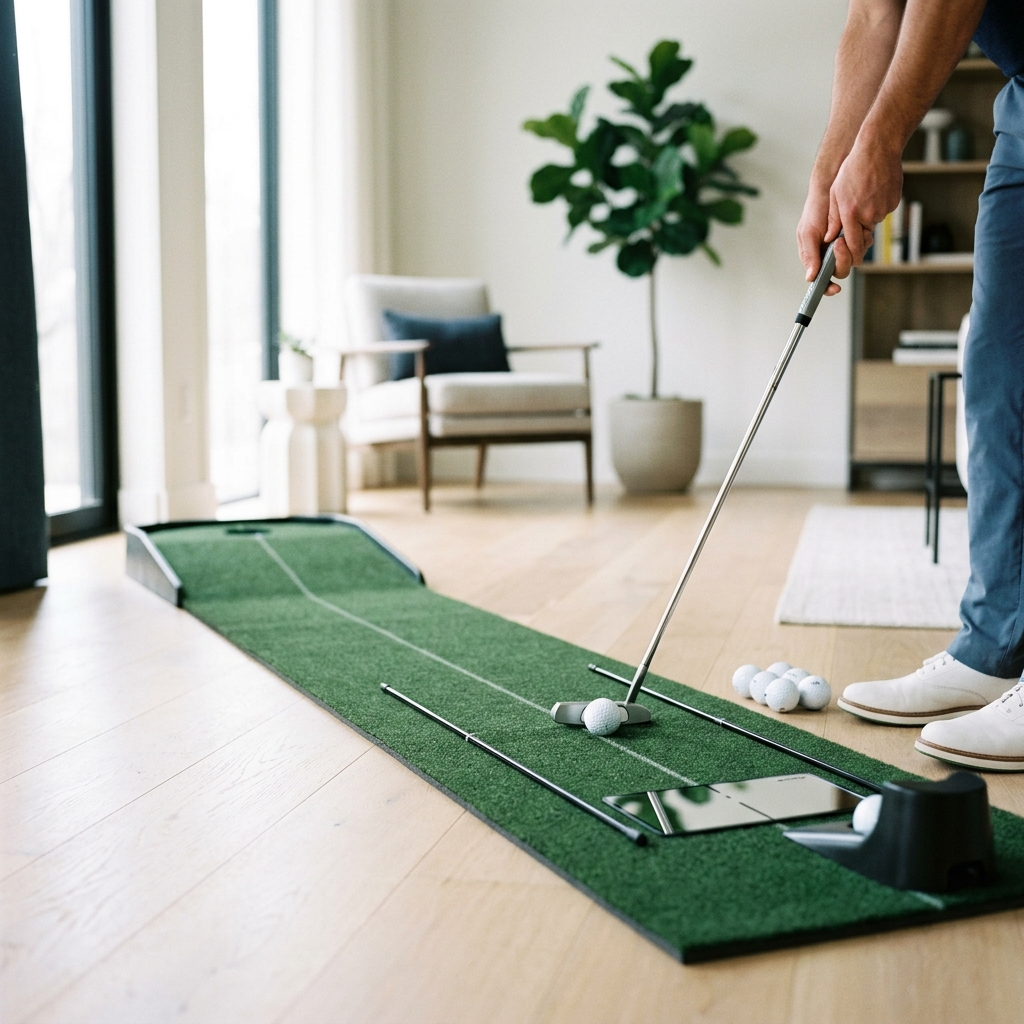
Setting Up Your Home Putting Space
Creating a dedicated practice area doesn’t require a huge investment or a lot of space. You can practice indoors or outdoors, depending on your climate and preferences. Here’s what to consider:
- Surface Type: Carpet can work for short putts, but for more realistic practice, consider an artificial putting green or a dedicated putting mat. Look for surfaces that offer consistent speed.
- Space Requirements: Even a 6-8 foot length is sufficient for many drills. You’ll need enough space to comfortably stand and stroke the ball.
- Lighting: Good lighting is crucial, especially for indoor practice. Ensure adequate illumination to clearly see the ball and your putting line.
- Noise Concerns: Indoor practice can be noisy, especially if you’re using a firm surface or repeatedly hitting a ball. Consider using foam practice balls or setting up your space in a less sensitive area.
Fundamental Putting Drills for Consistency
Before tackling distance control, establish a solid foundation with these drills focusing on grip, stance, and stroke path:
Clock Drill
Imagine your putting stroke as a clock face. Place a ball at each ‘hour’ (e.g., 3 o’clock, 6 o’clock, 9 o’clock) around the hole. Practice consistently stroking the ball from each position, focusing on a smooth, pendulum-like motion. This helps visualise different distances and promotes a consistent stroke path.
Gate Drill
Place two tees slightly wider than your putter head a few inches in front of the ball, creating a ‘gate’. The goal is to stroke the ball through the gate without hitting the tees. This drill reinforces accuracy and a square putter face at impact.
Towel Drill
Place a small rolled-up towel under your trail elbow (right elbow for right-handed golfers). This encourages keeping your elbows connected during the stroke, promoting a consistent plane. Practice making strokes while maintaining contact with the towel.
Distance Control Drills: Mastering Lag Putting
Lag putting is arguably the most challenging aspect of putting. These drills will help you develop a feel for distance control:
Ladder Drill
Place balls at progressively increasing distances from the hole (e.g., 3ft, 6ft, 9ft, 12ft). Attempt to hole each putt in sequence. This builds confidence and a sense of distance calibration.
Speed Drill
Place multiple balls at the same distance (e.g., 20ft) from the hole. Focus on varying your stroke speed to get each ball as close to the hole as possible. The goal isn’t necessarily to hole each putt, but to consistently control the distance.
Coin Drill
Place a coin a few feet past the hole. The aim is to putt the ball past the hole, stopping as close to the coin as possible. This drill demands precise distance control and helps you learn to read the speed of the green (or your practice surface).
Reading Greens at Home: Simulation & Practice
Green reading is a skill that can be honed even without access to a golf course. Here’s how to simulate it at home:
- Books & Apps: Utilize golf instruction books or apps (many integrate with devices like the TomTom Golf GPS Watch – £250.00) that provide detailed explanations of green reading techniques.
- Subtle Breaks: Create subtle breaks in your practice surface by placing a towel or small object underneath one side of your putting mat. This simulates the slopes you’ll encounter on the course.
- Visualisation: Before each putt, spend time visualizing the break and the path the ball needs to take to reach the hole.
Advanced Putting Drills for Competitive Play
These drills are designed for golfers looking to refine their game under pressure:
Pressure Putting Drill
Use the PuttOUT Pressure Putt Trainer (£60.00). This device creates a realistic hole size and provides feedback on your putting accuracy. Practice with a specific target score (e.g., make 10 out of 10 putts) to simulate tournament conditions.
Blind Putting Drill
Close your eyes and focus on your feel for the stroke. Attempt to putt the ball into the hole without looking. This improves your sense of distance and stroke mechanics.
Multiple Ball Drill
Place 3-5 balls around the hole at varying distances. Attempt to hole all the putts in quick succession. This simulates the pace of play during a round and forces you to maintain accuracy under pressure.
Essential Putting Equipment for Home Practice (2026)
Investing in the right equipment can significantly enhance your practice sessions.
| Product | Description | Price (GBP) | Pros | Cons |
|---|---|---|---|---|
| SKLZ Putting Mat | A popular, affordable putting mat for indoor practice. | £45.00 | Good value, portable, suitable for beginners. | Surface speed may not be realistic. |
| Rife Putters Alignment Stick | Helps with alignment and stroke path. | £20.00 | Simple, effective, affordable. | Requires additional equipment (e.g., putting mat). |
| PuttOUT Pressure Putt Trainer | Provides realistic pressure putting practice with feedback. | £60.00 | Excellent for developing pressure putting skills. | Can be challenging for beginners. |
| Golfsmith Putting Green | High-quality artificial putting green for realistic practice. | £120.00 | Realistic speed and feel, durable, large surface area. | More expensive, requires more space. |
| Odyssey Stroke Lab Black Putter | A popular putter known for its stability and feel. (Use for practice) | £200.00 | Excellent feel, improved consistency, forgiving. | Personal preference is key. |
| Bushnell Golf Ball Finder | Helps locate lost practice balls. | £30.00 | Saves time and frustration. | Not essential but useful. |
Troubleshooting Common Putting Problems
Here’s how to address common putting issues:
- Pushing: Your putter face is open at impact. Practice the Gate Drill to promote a square face.
- Pulling: Your putter face is closed at impact. Focus on a smooth takeaway and avoid manipulating the putter face.
- Inconsistent Distance: Work on the Ladder Drill and Speed Drill to develop a better feel for distance control.
- Alignment: Use an alignment aid (like the Rife Alignment Stick) to ensure you’re consistently aiming at your target.
Integrating Practice into Your Weekly Routine
Consistency is key. Here’s a sample weekly schedule:
- Monday: Fundamental Drills (Clock Drill, Gate Drill) – 20 minutes
- Wednesday: Distance Control Drills (Ladder Drill, Speed Drill) – 30 minutes
- Friday: Advanced Drills (Pressure Putting Drill, Blind Putting Drill) – 20 minutes
- Weekend: Combined practice session – 45 minutes
Don’t be afraid to vary the drills and practice durations to keep things interesting and avoid plateaus.
Conclusion: Putting Practice – The Key to Lower Scores
Putting is often the difference between a good round and a great round. By dedicating time to focused practice, utilising the drills outlined in this guide, and investing in the right equipment, you can significantly improve your putting consistency and lower your scores. Remember, even 15-20 minutes of practice each day can make a world of difference. So, take control of your short game and elevate your performance on the course!
FAQ
Q: How much space do I need for a home putting practice area?
You can effectively practice with as little as 6-8 feet of space. The key is to focus on quality practice, not necessarily quantity.
Q: What is the best surface to practice on at home?
Artificial putting green or a dedicated putting mat offer the most realistic experience. However, carpet can be used for shorter putts.
Q: How often should I practice putting?
Ideally, you should practice putting several times a week, even if it’s just for 15-20 minutes each session. Consistency is more important than duration.
Q: Are expensive putting aids necessary?
Not necessarily. Simple aids like alignment sticks and balls are very effective. More advanced aids like the PuttOUT Trainer can be beneficial, but aren’t essential for beginners.
Q: How can I simulate green reading at home?
Use golf instruction materials, apps, or create subtle breaks in your practice surface to mimic the slopes you’ll encounter on the course.