
Last updated:
The PRGR HS-130A is a compact choice for checking swing speed and ball speed without building a simulator around a phone or computer. Its carry and total distances are estimates. Buy it for a clear speed-feedback task, and understand how those estimates are produced before using them to judge your clubs.
Check the model suffix on the actual unit and manual. PRGR also lists HS-130 and HS-130 BLE devices in Japan. A listing that simply says “PRGR launch monitor” does not tell you which version you are buying or establish the HS-130A’s connectivity.
Link disclosure: The manufacturer and support links below are direct information links. No affiliate commission is assumed from them.
Guide checked: 9 September 2026. This article uses the linked manufacturer information. We have not carried out hands-on testing. Confirm the exact version and current buying terms before ordering.
| Reading or use | What the manual establishes | Practical limit |
|---|---|---|
| Club and ball speed | Speed readings appear on the unit | Correct direction and height still matter |
| Carry and total | Estimated from ball speed and average club launch/spin | Not a measurement of your actual landing point |
| Practice swing | Club-head speed can be measured without a ball | No valid ball speed, smash or carry from that swing |
| Shot shape | Distance calculation does not consider direction | Cannot resolve a left/right dispersion question |
| Model name | HS-130A manual; Japanese BLE model is separately named | Do not assume Bluetooth from the brand name |
Table of Contents
Choose the job before choosing the monitor
The clearest use is a repeatable speed session: observe normal swings, make one deliberate change and compare a sensible group of readings. A standalone display is useful when you want feedback between swings without managing a simulator connection.
If your question is where the face points, why a shot curves or how widely shots disperse, this device’s distance number does not answer it. Decide whether speed alone supports your practice plan. A coach can help you choose the measurement you need before you spend on additional technology.
Why the selected club changes the estimate
The HS-130A manual explains that estimated distance uses measured ball speed together with average launch angle and spin values for the selected club. It also says the direction of the shot is not considered. Select the club you are actually using and check whether the display is in carry or total mode.
This matters when two shots leave with similar speed but different flight characteristics. A low runner and a higher shot can demand different decisions on the course, even if a speed-based estimate looks similar. Use the distance display as contextual practice feedback, and confirm real carry gaps through observed shots in appropriate conditions.
Position the HS-130A for a repeatable reading
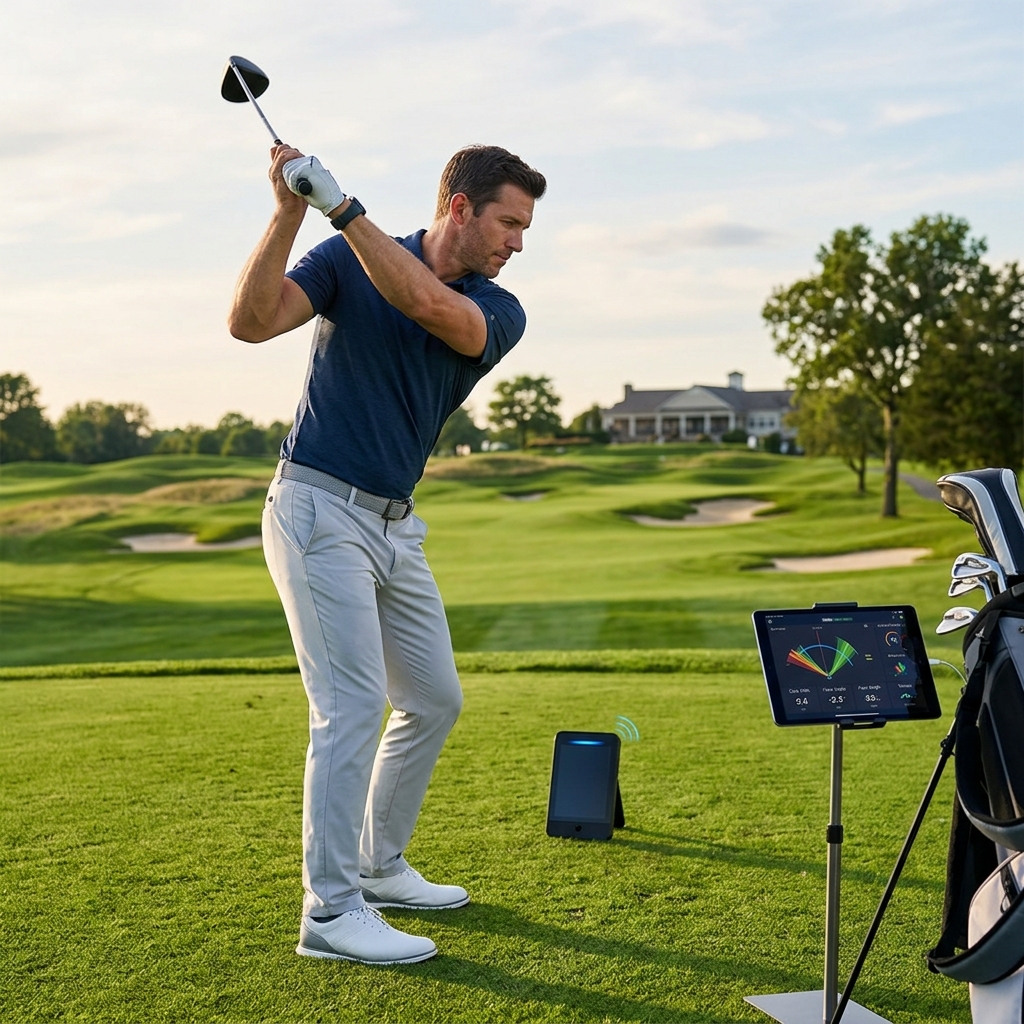
The manual’s golf setup places it 3.5–5 feet behind the ball on a flat surface, aligned with the launch direction and at the correct height. It also requires an unobstructed view between the device and ball. Follow the illustrated setup for this model rather than copying a different radar monitor’s spacing.
Mark a repeatable position at your practice area and confirm it after moving a mat or stand. Change one setup variable at a time if readings are inconsistent. A quick test with the unit badly aimed is not a useful basis for deciding that a swing change worked.
Use practice-swing speed for the right purpose
The HS-130A can record club-head speed without a ball. That makes it relevant to a session in which the explicit aim is observing swing speed. A practice swing does not provide a real ball-speed, smash-factor or distance result, even if the instrument occasionally displays an incidental number.
Keep practice-swing records separate from struck-shot records. The two tasks demand different feedback: one follows movement speed, while the other also asks what happened at impact. Avoid presenting a faster rehearsal as proof that your normal playing shot now carries farther.
Check the unit rather than a loosely named listing
The manufacturer’s Japanese range contains the separately named HS-130 BLE. Its name is a reason to verify the label, not to assume an HS-130A has Bluetooth or an app connection. Use the English HS-130A manual for the product discussed here and confirm the supplied version through a UK seller or the JS Golf Brands route.
For a used purchase, ask to see a clear display, functioning controls, the battery compartment and the model marking. Request a demonstration showing both a practice-swing reading and a struck shot if that can be done in a suitable practice area. Those checks are more useful than an unlabelled photograph of a distance result.
Plan the simple ownership details
The manual specifies four AAA alkaline batteries and states that the unit is not waterproof. Include batteries and a suitable dry place for practice in your ownership plan. A covered range bay can be more practical than leaving it exposed on wet ground.
The UK distributor describes a history of up to 500 measurements. Decide how you will turn those readings into a useful record: note the date, club and purpose of each session, and avoid mixing several experiments together. The HS-130A makes most sense when that straightforward workflow is sufficient and you do not need a simulation or detailed directional-analysis system.
Check the named products
View PRGR UK distributor range information
Compare the trade-offs with other devices in our lower-cost launch monitor buying guide.