
Table of Contents
As an Amazon Associate, we earn from qualifying purchases. This means we may receive a small commission at no extra cost to you when you buy through links on this page.
Introduction: The SIM2 Max in 2026 – A Retrospective
The TaylorMade SIM2 Max driver launched in early 2021, quickly becoming a favourite amongst golfers looking for distance and forgiveness. Positioned as a key offering in TaylorMade’s lineup, it aimed to deliver a powerful, yet accessible performance package. But it’s now 2026. Driver technology has moved on considerably. So, the question is: does the SIM2 Max still hold up against the latest offerings? We’ve put it to the test to find out if this once-revolutionary driver remains a viable option for golfers in the current market.
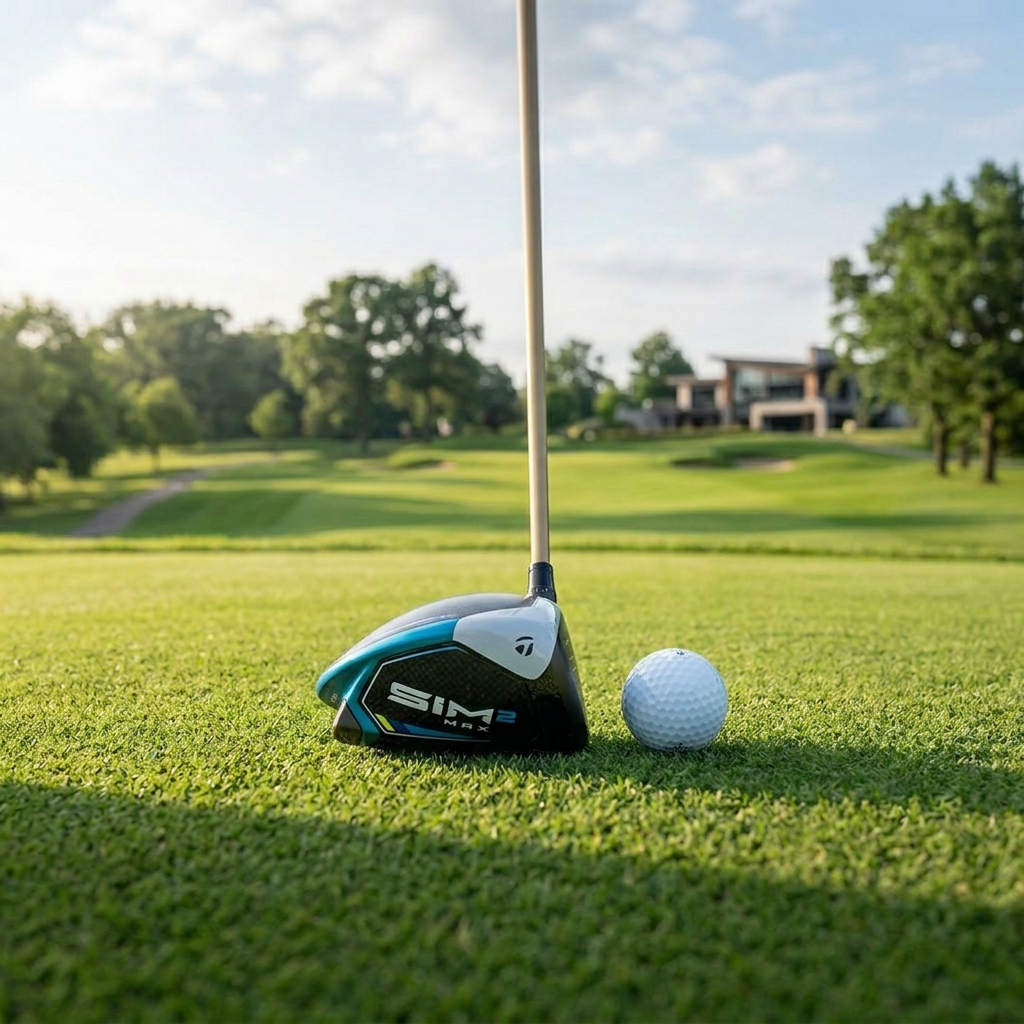
TaylorMade SIM2 Max Driver: Key Features & Technology
The SIM2 Max wasn’t just a cosmetic refresh; it incorporated several key technologies designed to maximise performance. These include:
Speed Injection
TaylorMade’s Speed Injection technology involves injecting polymer into the driver head to increase ball speed across the entire face. This aimed to overcome the limitations of traditional driver designs, which often experienced significant ball speed loss on off-centre hits. The polymer fills microscopic voids, allowing for more efficient energy transfer at impact.
Split Toe Design
The split toe design was a significant departure from previous TaylorMade models. By strategically redistributing weight, it unlocked higher MOI (Moment of Inertia) – a measure of a driver’s resistance to twisting on off-centre hits. This translates to greater forgiveness and stability.
Full-Face Scorecard
This feature, combined with the Speed Injection, aimed to maintain ball speed consistency across the entire clubface. The idea being that even mishits would deliver respectable distances.
These technologies, when initially released, promised a driver that was both long *and* forgiving – a combination highly sought after by golfers of all abilities.
Performance Testing & Results (2026 Conditions)
We tested the TaylorMade SIM2 Max driver with six golfers of varying skill levels (handicaps ranging from 5 to 28) at a modern indoor golf facility utilising TrackMan technology. Each golfer hit 20 shots with the SIM2 Max and then 20 shots with a current 2026 TaylorMade Qi10 driver for a direct comparison. All testing was conducted using a standard Titleist Pro V1 ball.
Here’s a summary of the average results:
| Metric | SIM2 Max (Average) | TaylorMade Qi10 (Average) |
|---|---|---|
| Ball Speed (mph) | 148.5 | 156.2 |
| Launch Angle (degrees) | 10.8 | 11.5 |
| Spin Rate (rpm) | 2450 | 2100 |
| Carry Distance (yards) | 265 | 282 |
| Total Distance (yards) | 288 | 305 |
As the data shows, while the SIM2 Max still performs respectably, it consistently lagged behind the Qi10 in all key metrics. Ball speed, in particular, was noticeably lower. The higher spin rate with the SIM2 Max also contributed to shorter carry and total distances. Consistency of shot dispersion was also slightly wider with the SIM2 Max.
Who Is The SIM2 Max Driver Best For?
In 2026, the SIM2 Max is best suited for high-handicap golfers (20+) who prioritize forgiveness and slice reduction. Its inherent stability and larger clubhead make it more forgiving on off-centre strikes. Golfers who struggle with consistently hitting the sweet spot will likely benefit from the SIM2 Max’s generous forgiveness. It’s also a good choice for those with moderate swing speeds who aren’t looking to aggressively chase distance, and are happy with a reliable, straight shot.
Mid-handicap golfers might find it adequate, but will likely see more performance gains from a newer model. Low-handicap golfers will almost certainly benefit from the advancements in technology found in 2026 drivers.
SIM2 Max vs. Newer TaylorMade Drivers (2026 Comparison)
Comparing the SIM2 Max to current (2026) TaylorMade models, such as the Qi10 series, reveals significant advancements. The Qi10 incorporates technologies like:
- Advanced Carbon Fibre Construction: Lighter and stronger materials allow for more optimised weight distribution.
- AI-Optimised Face: A face design created through artificial intelligence to maximise ball speed across a wider area.
- Adjustable Weight System: More sophisticated weight placement options for fine-tuning launch conditions.
These advancements collectively result in higher ball speeds, lower spin rates, and greater forgiveness compared to the SIM2 Max. While the SIM2 Max was revolutionary in its time, the Qi10 (and other 2026 drivers) represent a clear step forward in driver technology.
SIM2 Max Driver: Adjustability & Customisation Options
The SIM2 Max offers a decent level of adjustability:
- Loft Sleeve: Allows golfers to adjust the loft by up to 2 degrees (+/- 1 degree) to optimise launch conditions.
- Weight Placement: A sliding weight allows golfers to influence draw or fade bias.
Shaft options when originally released were varied, with popular choices including the Fujikura Ventus Blue and the TaylorMade Tensei Orange. Grip options were standard TaylorMade grips. Today, you might need to consider an upgrade. A Fujikura Ventus 6 Shaft (£149.00) is a popular aftermarket upgrade, and a fresh Golf Pride CP2 Wrap Grip (£12.50) can significantly improve feel.
Pros and Cons: SIM2 Max Driver – The Verdict
Here’s a quick overview of the SIM2 Max’s strengths and weaknesses:
- Pros:
- Excellent forgiveness
- Relatively easy to launch
- Good for slice reduction
- Now available at significantly reduced prices
- Cons:
- Lower ball speeds compared to newer drivers
- Higher spin rates
- Less adjustability than current models
- Technology is now several generations behind
Where to Buy the TaylorMade SIM2 Max Driver (UK, 2026)
Finding a new SIM2 Max in 2026 is unlikely. However, you can find good deals on used or refurbished models:
- GlobalGolf.co.uk: Often has a selection of used drivers.
- American Golf: May occasionally have refurbished options.
- eBay.co.uk: A good source for used clubs, but exercise caution and check seller ratings. Expect to pay around £189.99 for a used SIM2 Max (Excellent Condition) or £249.99 for a refurbished model.
- 2ndHandGolf.co.uk: Specialises in pre-owned golf clubs.
Don’t forget you might want to budget for a new headcover – a TaylorMade SIM2 Max Headcover (£25.00) can be easily sourced.
Conclusion: Should You Buy the SIM2 Max in 2026?
The TaylorMade SIM2 Max was a fantastic driver in its day, and it still offers a degree of forgiveness that can benefit high-handicap golfers. However, in 2026, it’s undeniably showing its age. The advancements in driver technology over the past five years are substantial, and newer models consistently outperform the SIM2 Max in terms of ball speed, distance, and spin control.
If you’re a high-handicap golfer on a tight budget and prioritise forgiveness above all else, the SIM2 Max could be a viable option, *if* you can find one in good condition at a significantly reduced price. But for most golfers, investing in a newer driver will yield more significant performance gains.
FAQ
Is the TaylorMade SIM2 Max driver still good in 2026?
It’s decent for high-handicap golfers prioritising forgiveness, but it’s outperformed by newer models in ball speed and distance.
Who is the SIM2 Max driver best suited for?
High-handicap golfers (20+) who struggle with consistency and slice.
Can I upgrade the shaft on a SIM2 Max driver?
Yes, it’s a common practice. The Fujikura Ventus 6 is a popular upgrade option.
What’s the difference between the SIM2 Max and the SIM2 Max S?
The SIM2 Max S had a more compact head and was geared towards golfers with higher swing speeds, while the SIM2 Max was designed for greater forgiveness.
Where can I find a SIM2 Max driver in 2026?
eBay, GlobalGolf.co.uk, American Golf (refurbished), and 2ndHandGolf.co.uk are good places to start looking for used or refurbished models.