
Last updated:
Golf GPS and a laser rangefinder answer different distance questions. GPS uses mapped course information to show relevant yardages; a laser measures to a target you aim at. Choose the information that fits your routine. You may prefer a quick green reference, a visible-target measurement or both, but there is no need to buy two devices before identifying what your current setup is missing.
Link disclosure: This guide links directly to manufacturer and retailer information. No commission is assumed from these links.
Guide checked: 8 September 2026. This article uses the linked manufacturer and retailer information. We have not carried out hands-on product testing. Confirm the exact specification and current offer before buying.
| Question | GPS approach | Laser approach |
|---|---|---|
| How far to mapped parts of the green? | Typically provides mapped references | Requires a visible target to measure |
| How far to that visible feature? | Depends on available map functions | Aim directly at the intended target |
| What lies farther along this hole? | A suitable map view may help | Does not itself provide a full-hole map |
| What preparation is needed? | Course information, charge and setup | Power check and familiar targeting controls |
Table of Contents
Start with the information you actually use
Think about your last few approach shots. Were you looking for a general green distance, the exact visible flag distance or a better picture of the hole? A device should answer a repeated question rather than add more numbers to a decision that was already clear. If your current method works, describe the missing information before shopping.
If you want to study the whole hole before playing, compare those devices with a course-specific yardage book. To connect any yardage reading to a club choice, keep your own carry measurements in the free distance worksheet.
Keep distance separate from club choice. You still need to consider your normal shot, landing area and conditions. Neither a map nor a laser knows every detail of the shot you intend to play. More precise-looking digits do not remove the need for judgment.
Handheld GPS: Shot Scope H4
The H4’s checked information includes front, middle and back green yardages along with hazard and lay-up distances. It is a relevant comparison if you want GPS information without wearing a watch. Check how you would attach, carry and retrieve the unit during a round.
If optional tracking interests you, read the exact requirements and decide whether that recording routine is worthwhile. A handheld distance device should first be comfortable to use for its main job. Additional data is useful when you have a plan for reviewing it, not simply because it can be collected.
Read the product details for Shot Scope H4 GPS handheld at Shot Scope
Watch GPS: Garmin Approach S12
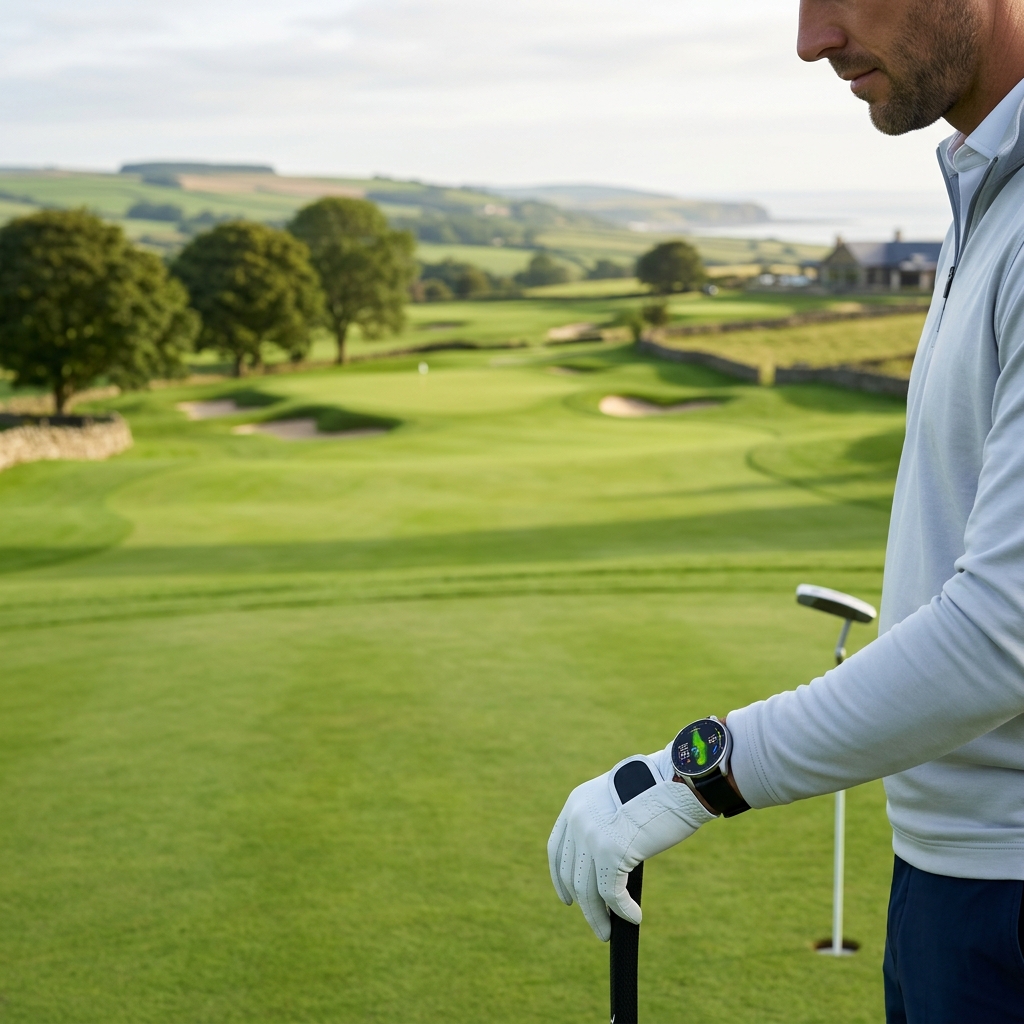
The S12 is a wrist-based example for a yardage-led routine. Consider whether glancing at your wrist is more convenient than reaching for another device. Confirm course support and the information shown on the exact model.
Try the strap and controls before deciding. If a watch distracts you during the swing, the form factor may outweigh its convenience between shots. GPS does not require you to choose a watch; the information and the way you carry it are separate decisions.
Laser example: Shot Scope PRO L2
The PRO L2 is a laser candidate with slope functionality in the checked specification. It measures to the target you aim at rather than supplying a complete hole map. Practise acquiring and confirming an intended target before treating the displayed number as settled.
Check the power and carrying routine as carefully as the optics. If you often forget a loose accessory on a buggy, choose a consistent storage habit before relying on a magnetic attachment. The useful device is one you can retrieve, use and return without disrupting play.
Read the product details for Shot Scope PRO L2 rangefinder at Shot Scope
Understand where each approach can be inconvenient
A GPS choice depends on appropriate course information and correct setup. Verify your actual layout and learn how to handle an unexpected hole selection or mapping issue. A detailed map can help orientation, but the controls need to be usable when you are ready to play.
A laser depends on finding a suitable visible target and aiming at it correctly. Repeat a reading that seems inconsistent with the hole and your surroundings. If the question concerns a hidden landing area, a direct line-of-sight measurement may not be the information you need. Choose based on the question rather than forcing one device into every situation.
Could using both be worthwhile?
Both can be useful when you have a clear division of tasks, such as a mapped green reference alongside a visible flag measurement. Try the simpler setup first and notice whether a second device would resolve a recurring gap. Duplicate information is not automatically better information.
For organised play, check The R&A’s equipment rules and event conditions, including the use of adjusted distances or other restricted functions. Learn the permitted mode for each device. Owning two tools makes it more important to understand their controls, not less.
Make the buying decision concrete
Choose GPS if mapped references and convenient access answer most of your questions. Choose a laser if visible-target measurements are the main missing piece and you can aim the shortlisted unit comfortably. Compare the complete cost, including any membership needed for desired GPS features.
Our GPS watch guide and laser guide explain the model-level checks. Start with one clear information need and buy the device that serves it reliably in your normal round.