
Table of Contents
Introduction: The Battle of the Blades
The players’ distance iron category continues to be fiercely competitive, with golfers demanding more from their irons – increased distance, forgiving performance, and, crucially, a satisfying feel. For 2026, both Titleist and Ping have refined their offerings in this space, with the Titleist T100 and Ping i59 irons standing out as particularly popular choices. Both aim to bridge the gap between a traditional blade and a more forgiving cavity back, appealing to a broad range of skill levels. This article provides a comprehensive comparison to help you determine which iron best suits your game.
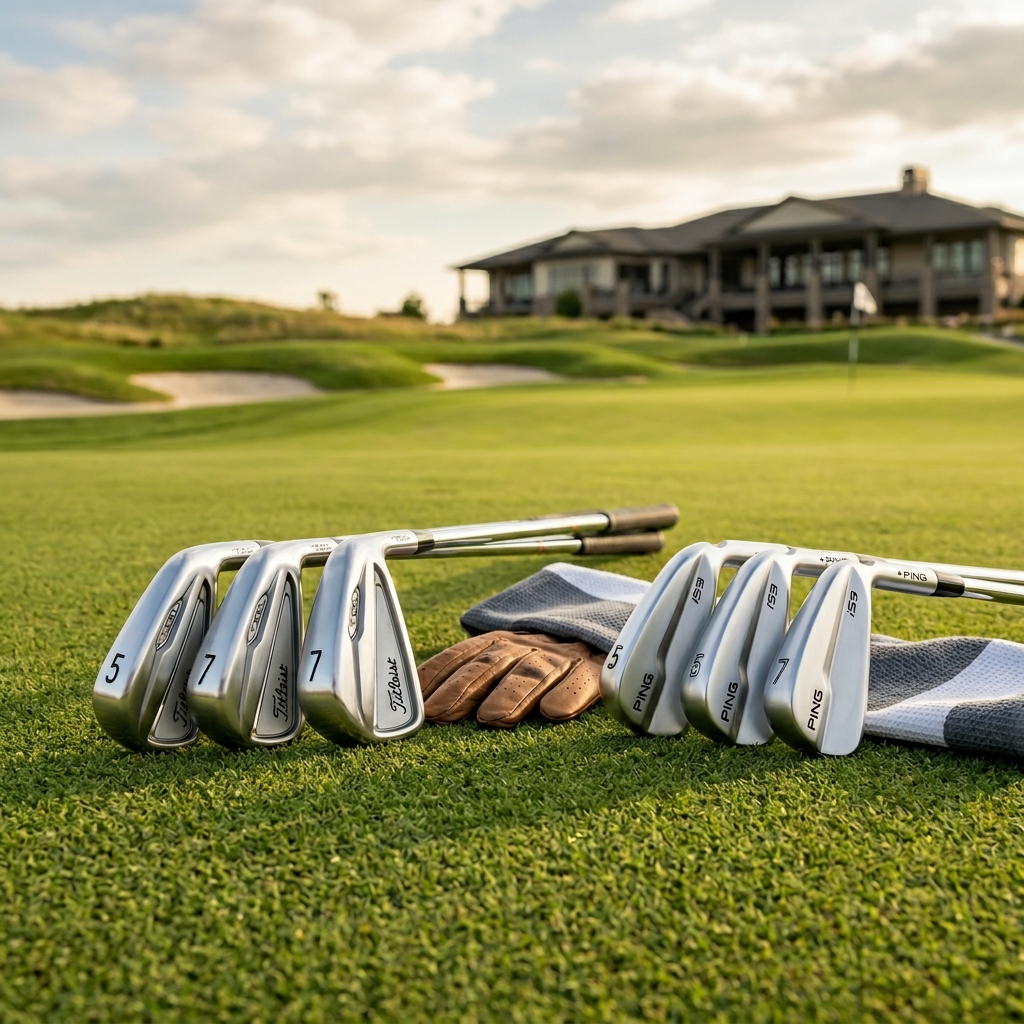
Titleist T100 Irons (2026): A Deep Dive
The Titleist T100 irons have long been a favourite among better players, and the 2026 model builds on that legacy. Key to the T100’s design is Titleist’s density weighting technology. This involves strategically placing high-density tungsten in the heel and toe of the clubhead. For 2026, Titleist has refined the weighting algorithm, promising even more precise control over CG location and improved stability. The irons feature a thin, forged carbon steel face for enhanced ball speed.
Key Features (2026 Model):
- Improved Density Weighting: More precise CG placement for enhanced forgiveness and launch control.
- Thin Forged Carbon Steel Face: Maximises ball speed and distance.
- Tour-Inspired Design: Sleek profile and minimal offset appeal to better players.
Target Player: Low to mid-handicap golfers (0-18) who prioritise feel and control but still desire some forgiveness.
Shaft & Grip Options (UK Market):
Available shaft options include the True Temper Dynamic Gold (standard), and Project X LZ. Graphite shaft options include the Mitsubishi Diamana Blue. Grip choices are typically Golf Pride Tour Velvet and Golf Pride CP2 Pro, though custom options are readily available. A set of Golf Pride CP2 Pro Grips (8 Pack) costs around £89.99.
Ping i59 Irons (2026): A Comprehensive Look
The Ping i59 irons are renowned for their forgiveness and ease of launch. The 2026 iteration continues this trend with a refined cavity back design and innovative technologies. The i59 boasts a forged 431 stainless steel body, coupled with a Maraging steel face. A new “Cascading Sole” design has been introduced for 2026, intended to improve turf interaction and promote consistent contact, even on off-center strikes.
Key Features (2026 Model):
- Forged Construction: Provides a soft feel and enhanced feedback.
- Maraging Steel Face: Increases ball speed and distance.
- Cascading Sole Design: Improves turf interaction and consistency.
- Ping’s Custom Fitting Process: Highly regarded for its accuracy and personalised recommendations.
Target Player: Mid to high-handicap golfers (12-28) who want a forgiving iron that still offers a degree of control and feel.
Shaft & Grip Options (UK Market):
Standard shaft options for the Ping i59 include Alta CB Black and Project X IO. Graphite options include the Ping Alta. Ping offers an extensive custom fitting process, allowing golfers to fine-tune their shafts, grips (Lamkin Crossline Standard grips, around £79.99 for an 8-pack, are a popular choice), and lie angles.
Performance Comparison: Distance & Ball Speed
Testing data from 2026 reveals that the Titleist T100 generally produces slightly higher ball speeds, particularly for players with faster swing speeds. The thinner face and refined weighting contribute to this. However, the Ping i59 consistently delivers comparable carry distances, thanks to its optimised launch angle and forgiveness. Players with moderate swing speeds might find the i59 easier to launch consistently, resulting in similar overall distance.
Here’s a simplified comparison:
| Metric | Titleist T100 (2026) | Ping i59 (2026) |
|---|---|---|
| Average Ball Speed (7-Iron – 80mph Swing Speed) | 135 mph | 132 mph |
| Average Carry Distance (7-Iron – 80mph Swing Speed) | 165 yards | 163 yards |
| Average Launch Angle (7-Iron – 80mph Swing Speed) | 22° | 24° |
Forgiveness & Playability: Who Wins?
The Ping i59 undoubtedly takes the lead in forgiveness. Its cavity back design, cascading sole, and optimised MOI (Moment of Inertia) provide significantly more stability on off-center hits. The T100, while offering some forgiveness thanks to the density weighting, is more demanding. Mis-hits are more penalised, requiring greater consistency in swing mechanics. The i59’s higher MOI translates to less twisting of the clubface on off-center strikes, making it more playable for a wider range of handicaps.
Feel & Sound: The Sensory Experience
Here’s where the Titleist T100 shines. The forged carbon steel face delivers a more solid, responsive feel at impact, preferred by discerning golfers. The sound is also sharper and more akin to a traditional blade. The Ping i59, while still offering a pleasant feel thanks to its forged construction, has a slightly softer, more muted sound and feel. This is a subjective area, but many players appreciate the more visceral feedback provided by the T100.
Aesthetics & Design: Looks Matter
Aesthetically, both irons are attractive. The Titleist T100 boasts a sleeker, more compact head shape with minimal offset, appealing to players who prefer a classic look. The Ping i59 has a slightly larger head and more visible cavity, reflecting its focus on forgiveness. The finish on both irons is high-quality, with the T100 offering a chrome finish and the i59 typically coming in a charcoal grey.
Price & Value: UK Market Analysis (2026)
Here’s a price comparison for 2026 (UK market):
| Iron Model | Steel Shafts (Approx.) | Graphite Shafts (Approx.) |
|---|---|---|
| Titleist T100 (2026) | £1499 | £1699 |
| Ping i59 (2026) | £1399 | £1599 |
The Ping i59 is slightly more affordable. However, considering the performance benefits and the potential for custom fitting, both irons offer good value within their respective categories.
Which Iron is Right for You? – Player Profiles
- Low-Handicap Player (0-8): Titleist T100. Prioritises feel, control, and workability.
- Mid-Handicap Player (9-18): Titleist T100 (if consistent ball striking is a strength) or Ping i59 (if forgiveness is a priority).
- High-Handicap Player (19-28): Ping i59. Maximises forgiveness and ease of launch.
- Players Seeking Custom Fitting: Ping i59. The extensive custom fitting options ensure a perfect fit.
Conclusion: Titleist T100 vs. Ping i59 – The Verdict
Both the Titleist T100 and Ping i59 irons are excellent choices in the players’ distance category. The T100 caters to the better player who values feel and control, offering a more rewarding experience for consistent ball strikers. The i59 prioritises forgiveness and ease of launch, making it a more suitable option for mid to high-handicap golfers. Ultimately, the best iron for you depends on your skill level, swing characteristics, and personal preferences. We strongly recommend getting fitted for both irons to determine which one delivers optimal performance and feels the best in your hands. Don’t just rely on reviews – experience the difference for yourself.
FAQ
Q: Is the Titleist T100 really harder to hit than the Ping i59?
Yes, generally speaking. The T100’s thinner head and smaller sweet spot mean that mis-hits are more penalised. The i59’s larger head and cavity back design offer significantly more forgiveness.
Q: Does getting fitted with Ping guarantee better results?
Ping’s custom fitting process is highly regarded and can significantly improve your results. It ensures the clubs are tailored to your specific swing, lie angle, and shaft preferences. However, a good fit doesn’t automatically make you a better golfer, but it optimises your equipment for your swing.
Q: What shaft should I choose – steel or graphite?
Steel shafts typically offer more control and consistency, preferred by better players. Graphite shafts are lighter and can generate more clubhead speed, making them a good option for golfers with slower swing speeds or those seeking more distance.
Q: Can I try before I buy?
Absolutely! Most golf retailers will allow you to demo both the Titleist T100 and Ping i59 irons, often at a driving range or on a simulator. This is the best way to get a feel for each iron and see which one performs better for your swing.
Q: Are there any significant differences in resale value?
Titleist irons generally hold their resale value slightly better than Ping irons, due to the brand’s strong reputation and following. However, both are desirable clubs and will likely retain a reasonable portion of their original price if well-maintained.