
Table of Contents
What is a Golf Rangefinder and Why Do You Need One?
A golf rangefinder is a handheld device used to accurately measure the distance to a target, most commonly the flagstick, but also hazards and lay-up points. Gone are the days of pacing off yardages or relying on course markers which can often be inaccurate. A rangefinder provides precise distances, allowing for more confident club selection and, ultimately, lower scores. The benefits are clear: increased accuracy, improved course management, and a significant boost to your overall game. Judging distance manually is prone to error, especially over undulating terrain or to unseen flag positions.
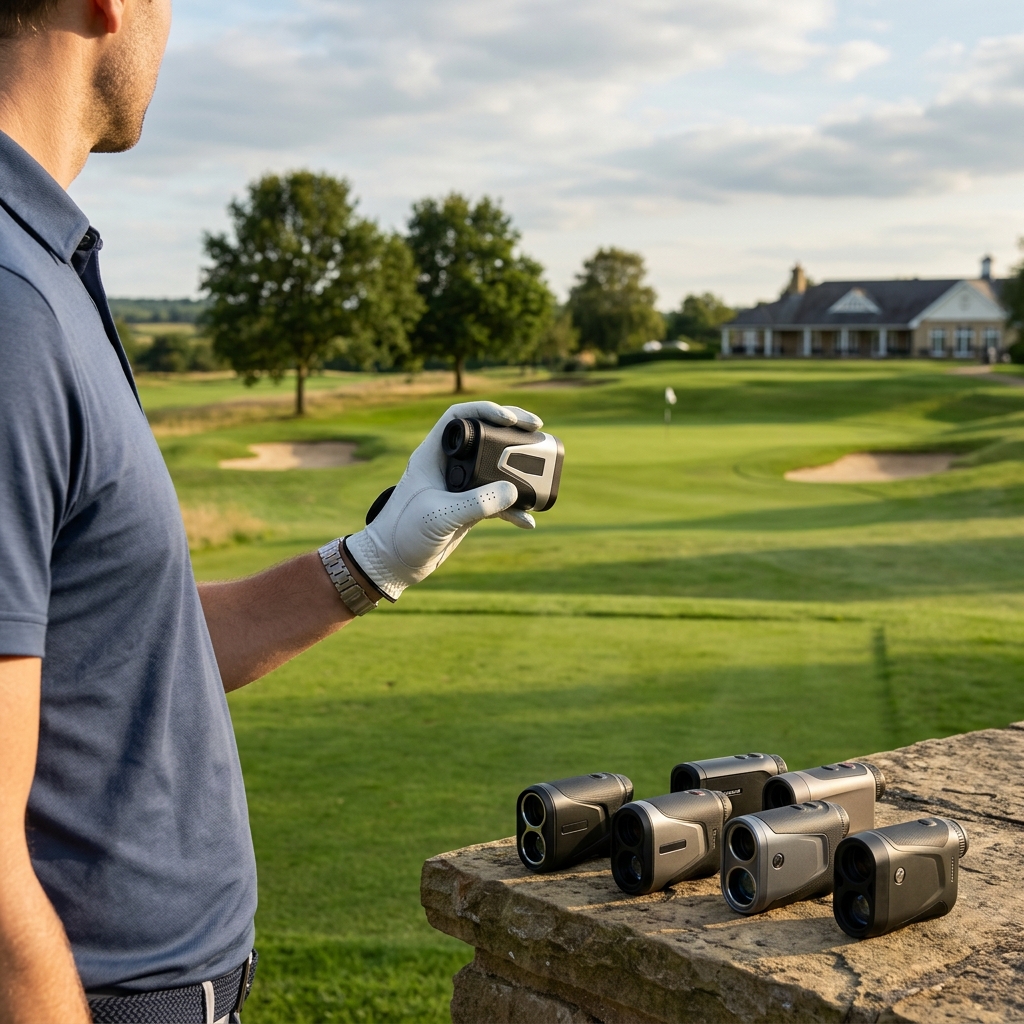
In competitive play, it’s important to check the rules of the competition regarding rangefinder usage. The R&A and USGA allow the use of rangefinders, provided they meet specific criteria (generally, they must only measure distance and not offer additional features like wind speed or slope). Always confirm the specific rules before a tournament.
Types of Golf Rangefinders: Laser vs. GPS
There are two main types of golf rangefinders: laser and GPS. Each has its strengths and weaknesses.
Laser Rangefinders
Laser rangefinders use a laser beam to pinpoint a target and calculate the distance. They are renowned for their accuracy and quick readings.
- Pros: Highly accurate, instant readings, work on any course (no subscription needed), compact and portable.
- Cons: Requires a clear line of sight to the target, can be less effective in fog or rain, requires aiming.
GPS Rangefinders
GPS rangefinders use satellite technology to determine your location and calculate distances to various points on the course. They often come preloaded with course maps and offer additional features.
- Pros: Provides distances to multiple points (front, back, carries), no line of sight required, often includes hazard information.
- Cons: Accuracy can be affected by obstructions (trees, buildings), requires a subscription for course updates, can be larger and heavier than laser rangefinders.
Here’s a comparison table:
| Feature | Laser Rangefinder | GPS Rangefinder |
|---|---|---|
| Accuracy | Very High (within 1 yard) | Good (within 3-5 yards) |
| Speed | Instant | Slight Delay |
| Course Dependence | Independent | Requires Pre-Loaded Courses/Subscription |
| Line of Sight | Required | Not Required |
| Price (Typical) | £150 – £700 | £200 – £800 |
Key Features to Consider in a Golf Rangefinder
Slope Compensation
Slope compensation calculates the adjusted distance based on the elevation change between you and the target. This is crucial for accurate club selection, particularly on undulating courses. Legality varies – check tournament rules. There are typically two types: true slope (shows adjusted distance) and tournament legal (can be switched off).
Pinseeker Technology
This technology helps the rangefinder lock onto the flagstick, even with background distractions like trees or other players. Crucial for quick and accurate readings.
Magnification
Measured in ‘x’, magnification helps you see the target more clearly. 6x or 7x magnification is common, but higher magnification can be beneficial for long distances.
Measurement Units
Most rangefinders allow you to switch between yards and meters. Choose the unit you’re most comfortable with.
Display Clarity
A clear, easy-to-read display is essential, especially in bright sunlight. Look for bright, high-contrast displays.
Water Resistance
Golfing can often involve unpredictable weather. A water-resistant or waterproof rangefinder will protect it from the elements.
Battery Life
Consider the battery life of the rangefinder. Longer battery life means less frequent charging or battery replacements.
Understanding Rangefinder Technology in 2026
By 2026, golf rangefinder technology is expected to have advanced significantly. We’re seeing improvements in optics with clearer lenses and enhanced light transmission. Signal processing has become faster and more reliable, reducing the time it takes to acquire a target. Bluetooth connectivity is now commonplace, allowing seamless integration with smartphone apps for course mapping and performance analysis.
One exciting development is the potential for AI-assisted rangefinding. AI algorithms can learn your playing habits and provide personalized club recommendations, taking into account factors like wind speed, temperature, and elevation. Some models are also incorporating augmented reality features, overlaying distance information onto the live view of the course through the rangefinder’s display. We’re also seeing more integration with smartwatches and golf GPS systems.
Top Golf Rangefinders UK 2026: Our Picks
Budget: TecTecTec ULT-X 900 (£149)
Pros: Affordable, easy to use, decent accuracy for the price.
Cons: Less advanced features, build quality not as premium.
Target Golfer: Beginners or golfers on a tight budget.
Mid-Range: Callaway 300 Laser Rangefinder (£299)
Pros: Excellent value for money, accurate readings, slope compensation, Pinseeker technology.
Cons: Display not as bright as some premium models.
Target Golfer: Intermediate golfers looking for a reliable and feature-rich rangefinder.
Mid-Range: Nikon Coolshot 5 (£279)
Pros: Compact, lightweight, excellent optics, good accuracy.
Cons: No slope compensation.
Target Golfer: Players desiring simplicity and clarity.
Premium: Bushnell Tour V6 Shift (£549)
Pros: Industry-leading accuracy, fast target acquisition, slope compensation (switchable), excellent build quality.
Cons: Expensive.
Target Golfer: Serious golfers who demand the best performance.
Premium: Leupold GX-5i3 (£429)
Pros: Pinpoint accuracy, excellent clarity, rugged design, prism lock technology.
Cons: Can be challenging to use in bright sunlight.
Target Golfer: Golfers who prioritize durability and precision.
Premium: Garmin Approach Z82 (£699)
Pros: Combines rangefinder and camera functionality, slope compensation, PlaysLike Distance, Wind Speed/Direction.
Cons: Very expensive, potentially complex feature set.
Target Golfer: Tech-savvy golfers who want a comprehensive, all-in-one device.
Mid-Range: Motocaddy Pro 3000i (£399)
Pros: Integrated with Motocaddy trolleys, clear display, accurate readings, slope compensation.
Cons: Best suited for Motocaddy trolley owners.
Target Golfer: Motocaddy trolley users looking for a seamless integration.
How to Choose the Right Golf Rangefinder for You
Consider your skill level, budget, and playing style. Beginners may benefit from a simpler, more affordable rangefinder like the TecTecTec ULT-X 900. Intermediate golfers can opt for a mid-range model with features like slope compensation and Pinseeker technology. Advanced golfers who demand the highest performance should consider a premium option like the Bushnell Tour V6 Shift or Garmin Approach Z82.
Think about the type of courses you play most often. If you frequently play on undulating terrain, slope compensation is essential. If you play in wet conditions, a waterproof rangefinder is a must. Also, if you prefer a hands-free experience, consider a rangefinder compatible with your golf trolley.
Golf Rangefinder Maintenance and Care
To ensure your rangefinder lasts for years, proper maintenance is crucial. Clean the lenses regularly with a microfiber cloth. Avoid exposing the rangefinder to extreme temperatures or direct sunlight for extended periods. Store it in a protective case when not in use. Replace batteries as needed and avoid mixing old and new batteries. Avoid dropping the rangefinder, as this can damage the internal components.
Frequently Asked Questions (FAQs)
1. Are golf rangefinders legal in all competitions?
Not necessarily. The R&A and USGA allow rangefinders, but only if they measure distance only. Rangefinders with slope adjustment or other features may be prohibited. Always check the specific rules of the competition.
2. How accurate are golf rangefinders?
Laser rangefinders are typically accurate to within one yard. GPS rangefinders are generally accurate to within 3-5 yards. Accuracy can be affected by factors like obstructions and weather conditions.
3. What is the typical battery life of a golf rangefinder?
Battery life varies depending on the model and usage. Most rangefinders offer around 5-10 rounds of golf on a single set of batteries.
4. How do I clean my golf rangefinder?
Use a soft, dry microfiber cloth to clean the lenses and the exterior of the rangefinder. Avoid using harsh chemicals or abrasive cleaners.
5. Can I use a golf rangefinder in the rain?
Many rangefinders are water-resistant or waterproof, but it’s still best to avoid prolonged exposure to heavy rain. If your rangefinder gets wet, dry it thoroughly before using it.