
For an indoor putting mat with ball return, check what happens to a holed putt, a missed putt and a ball that stops short. A return channel can make practice more convenient, but the raised target, available putting length and space beside the mat matter just as much.
This article contains affiliate links. We may earn a commission if you buy through them. It is based on published specifications and purchase checks; we have not tested these products. Prices and availability can change.
Table of Contents
A compact UK option: Longridge Putt N Hazzard
The Longridge PAPMH is a 200cm × 35cm mat with a raised cup, two hazard recesses and a return slope for holed balls. It is a useful starting point if you want a straightforward target-and-return setup. A ball is not included, and the stated dimensions describe the product rather than the entire space you need to stand and putt.
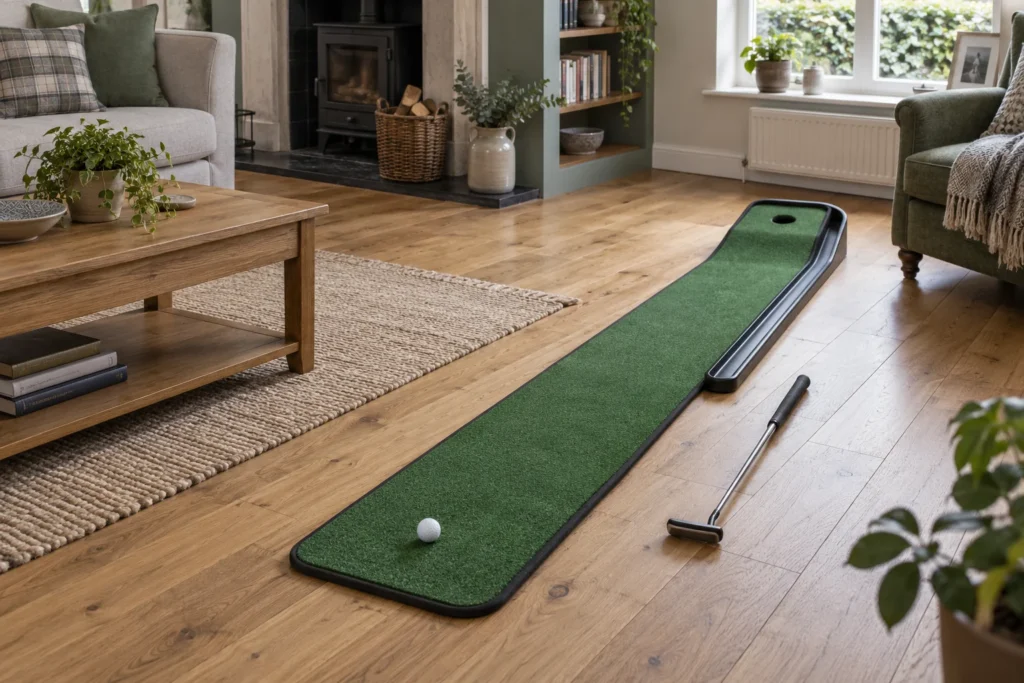
Compare the return mechanism first
| Format | Verified example | What to expect |
|---|---|---|
| Mat with a cup and return channel | Longridge Putt N Hazzard, PAPMH | Holed balls return; hazard recesses and short misses still need attention. |
| Another raised-hole return mat | Masters Deluxe Return Putting Mat, PE074 | The manufacturer describes a side alley returning holed balls; establish the exact footprint with the retailer. |
| Separate feedback ramp | PuttOUT Premium Pressure Putt Trainer | A ramp target used on a suitable surface; the returning distance is part of its feedback, rather than a full-length retrieval channel. |
The Longridge specification identifies PAPMH and the 200cm × 35cm size. Masters’ PE074 page describes a separate return-mat design. These are product references, not a claim that their surfaces or return performance are identical.
Measure the whole station
Mark out the mat, then stand beside the intended starting point with your putter. Check the space for your normal stance, the putter head and access to retrieve a missed ball. Leave the target end accessible too: even a return mat will occasionally need resetting or cleaning.
Pay particular attention to the side that carries the return channel. If the arrangement crowds your feet or puts the return directly in a household walking route, a different position or design may be more practical. Ask to see the assembled layout before ordering if the product photographs do not make the channel clear.
The mat length also exceeds the distance between your chosen starting point and the hole. You need space at both ends of that path. A two-metre product is not a promise of two-metre putts, and moving furniture for every session may matter more than a small difference in headline length.
Know what the ramp changes
Longridge’s specification describes an incline leading to a cup that is a quarter of an inch smaller than regulation. That makes the target different from an ordinary flat green. Judge a practice session against the same mat setup rather than treating its result as a direct prediction of how every course putt will behave.
A useful routine is to pick one starting position and record a short sequence of attempts. Then repeat from another available distance. Separate balls that stop short, miss the cup and reach the target. The return feature reduces some retrieval; it does not explain why a miss happened.
If your main task is stopping the ball within a pace zone, compare a flat marked mat as well. Our home putting-mat guide explains the space and practice choices. A physical hole can be engaging, but it is only one way to define a target.
A PuttOUT trainer is a different purchase
The Premium Pressure Putt Trainer is a separate folding target. Its manufacturer describes a parabolic ramp that sends accepted putts back a distance related to how far they would have passed the target. Do not read that as a guarantee that every ball returns to your feet.
If you already own a suitable putting surface, a separate target may be the smaller addition. If you need a complete rolling surface and a physical hole together, compare a return mat instead. When a photograph shows both a mat and trainer, check the actual package contents before assuming both are supplied.
Before buying a return mat as a gift
Find out where the recipient will use it and whether they already have a practice surface. Check packed storage as well as the laid-out dimensions, and include a suitable golf ball if the package omits one. For a shared room, consider how quickly the setup can be cleared away.
Choose the exact product code before comparing delivered prices. Similar-looking Longridge mats have different targets and layouts, so a generic brand search is insufficient. Keep packaging until the recipient has checked the setup within the seller’s return conditions.
Our guide to practising golf at home helps choose a manageable routine around the available space. The right return mat is the one whose target, footprint and resetting routine fit that session.