
Table of Contents
Introduction: Understanding Iron Types
Choosing the right irons is paramount for any golfer looking to improve their game. The two main categories – cavity back and blade irons – cater to vastly different skill levels and playing styles. Blade irons offer precision and feedback, while cavity backs prioritise forgiveness and ease of launch. In 2026, iron technology has advanced significantly, with manufacturers incorporating sophisticated materials and designs to enhance performance. Understanding these differences is key to selecting the clubs that will best unlock your potential.
What are Blade Irons?
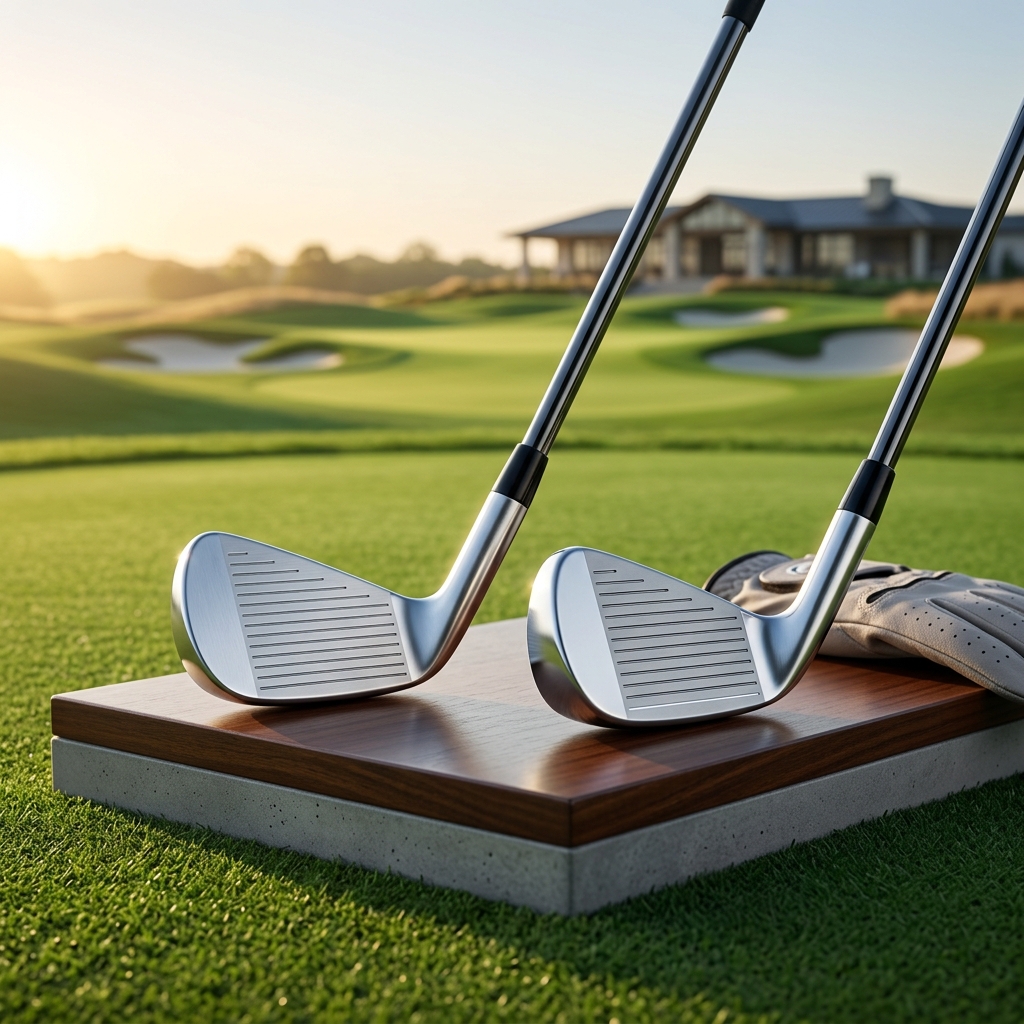
Blade irons, often referred to as musclebacks, are the traditional choice for skilled golfers. Their construction is characterised by a thin top line, minimal offset, and a solid blade-like head. The weight is concentrated directly behind the impact point, providing an exceptional feel for the golf ball. This direct feedback allows experienced players to precisely control shot shape and trajectory. The lack of forgiveness, however, means any mishit will be heavily penalised. Popular examples in 2026 include the Titleist T100 Irons (2026 Model) – £1499 and the Callaway Apex Pro 2026 Irons – £1299. They provide a classic look and feel demanded by purists.
What are Cavity Back Irons?
Cavity back irons, as the name suggests, feature a hollowed-out cavity on the back of the clubhead. This design dramatically shifts the weight distribution, moving it towards the perimeter of the clubface. This perimeter weighting increases the Moment of Inertia (MOI), making the club more resistant to twisting on off-centre hits – hence, the increased forgiveness. Cavity backs also typically have a wider sole, which aids in getting the ball airborne. The Cobra D9 Irons (2026) – £999 and Wilson Staff CB Irons (2026) – £899 are excellent examples, offering substantial forgiveness for a wide range of players. In 2026, cavity backs are increasingly incorporating advanced materials and face technologies to improve ball speed and distance.
Key Differences: Blade vs. Cavity Back – A Side-by-Side Comparison
| Feature | Blade Irons | Cavity Back Irons |
|---|---|---|
| Forgiveness | Low – punishing on mishits | High – more forgiving on off-centre strikes |
| Launch Angle | Lower – requires a more precise swing | Higher – easier to get the ball airborne |
| Workability | High – excellent for shaping shots | Moderate – shot shaping is more challenging |
| Feel | Exceptional – provides precise feedback | Good – feel is less direct, but still present |
| Aesthetics | Classic, sleek, minimalist | More bulky, designed for forgiveness |
| Difficulty Level | High – requires consistent ball striking | Low to Moderate – easier to hit consistently |
| Typical Player Handicap | Scratch to Single Digit | Mid to High Handicap |
A notable trend in 2026 is the blurring of lines between these two categories. Advancements in cavity back technology, such as tungsten weighting and variable face thickness, are bringing them closer to the performance of blades, appealing to increasingly lower handicap players.
Who Should Play Blade Irons?
Blade irons are best suited for low handicap golfers (typically single-digit handicaps) who possess a consistently repeatable swing. Experienced players who prioritise feel and workability will appreciate the control blades offer. They allow for precise manipulation of shot trajectory and spin, enabling them to shape shots with confidence. The Titleist T100 Irons (2026 Model) – £1499 and Mizuno Pro 225 Irons – £1349 are popular choices for this category.
Who Should Play Cavity Back Irons?
Cavity back irons are the ideal choice for mid to high handicap golfers, beginners, and anyone seeking more forgiveness and distance. They help mitigate the effects of common swing flaws, such as hitting the ball off-centre. The larger sweet spot and perimeter weighting make it easier to get the ball airborne and achieve consistent results. The Ping i230 Irons – £1199 and Srixon ZX5 Mk II Irons – £1099 provide excellent forgiveness and distance for a wide range of golfers. Cavity backs are particularly beneficial for players who struggle with consistency and want to improve their overall game.
Modern Innovations: Blending Blade & Cavity Back Technology (2026 Trends)
The landscape of iron design in 2026 is increasingly focused on bridging the gap between blades and cavity backs. ‘Players Distance’ irons have emerged as a popular category, aiming to combine the best of both worlds. These irons typically feature a compact head shape reminiscent of a blade, but incorporate cavity back technology, such as tungsten weighting strategically placed within the clubhead, to increase MOI and forgiveness. Variable face thickness is also a prominent feature, optimising ball speed across the entire face. The TaylorMade P790 Irons (2026) – £1399 exemplify this trend, offering a sleek look and feel with surprisingly high levels of forgiveness. Manufacturers are also experimenting with multi-material construction – using lightweight materials in the body combined with denser materials in key areas – to further refine weight distribution and enhance performance.
Fitting Tips: How to Choose the Right Irons for You
Getting professionally fitted for irons is crucial, regardless of your skill level. A fitter will assess your swing characteristics, including swing speed, launch angle, and impact position, to determine the optimal shaft flex, lie angle, and grip size. In 2026, launch monitors and swing analysis software have become even more sophisticated, providing detailed insights into your swing and helping identify areas for improvement. Don’t just rely on recommendations; try different irons and feel how they perform in your hands. Pay attention to how the club feels at impact and whether you can consistently hit the ball with the desired trajectory and distance.
Conclusion: Making the Informed Choice
The choice between cavity back and blade irons ultimately depends on your skill level, playing style, and personal preferences. Blade irons offer unparalleled feel and workability for experienced golfers with consistent swings, while cavity backs provide forgiveness and distance for those seeking to improve their game. In 2026, the emergence of ‘players distance’ irons offers a compelling compromise for golfers seeking a blend of both worlds. Don’t hesitate to seek professional advice from a qualified club fitter to ensure you select the irons that will best unlock your potential and help you enjoy the game of golf.
Our Top Pick: TaylorMade P790 Irons (2026) – £1399
For golfers seeking a balance of performance and playability, the TaylorMade P790 Irons are an excellent choice. They offer a sleek, modern design with surprisingly high levels of forgiveness, making them suitable for a wide range of skill levels. The innovative tungsten weighting and variable face thickness deliver exceptional ball speed and distance.
Frequently Asked Questions
What is the difference between offset and blade irons?
Offset refers to the amount the clubface is set back from the hosel (the part that connects the head to the shaft). Blade irons have minimal to no offset, while cavity backs often have more offset. Offset helps square the clubface at impact, promoting straighter shots and increased forgiveness.
Can a higher handicap golfer benefit from blade irons?
While generally not recommended, a higher handicap golfer with a very controlled swing *could* potentially benefit from blade irons. However, it would require significant practice and dedication to consistently hit the sweet spot. Cavity backs are almost always a better starting point for improvement.
How important is the shaft in choosing irons?
The shaft is incredibly important! It significantly impacts launch angle, ball speed, and overall feel. A shaft that is too stiff or too flexible for your swing will hinder performance. That’s why a professional fitting is essential to determine the correct shaft flex and weight.
What is MOI and why does it matter?
MOI (Moment of Inertia) is a measure of a clubhead’s resistance to twisting on off-centre hits. A higher MOI means the club will twist less, resulting in straighter shots even when you don’t hit the ball perfectly. Cavity back irons generally have higher MOIs than blade irons.
Are forged irons better than cast irons?
Forged irons are generally considered to offer a softer feel and more feedback, due to the manufacturing process. However, cast irons are often more durable and can be more forgiving. Both types have their advantages, and the best choice depends on your personal preferences and playing style.