
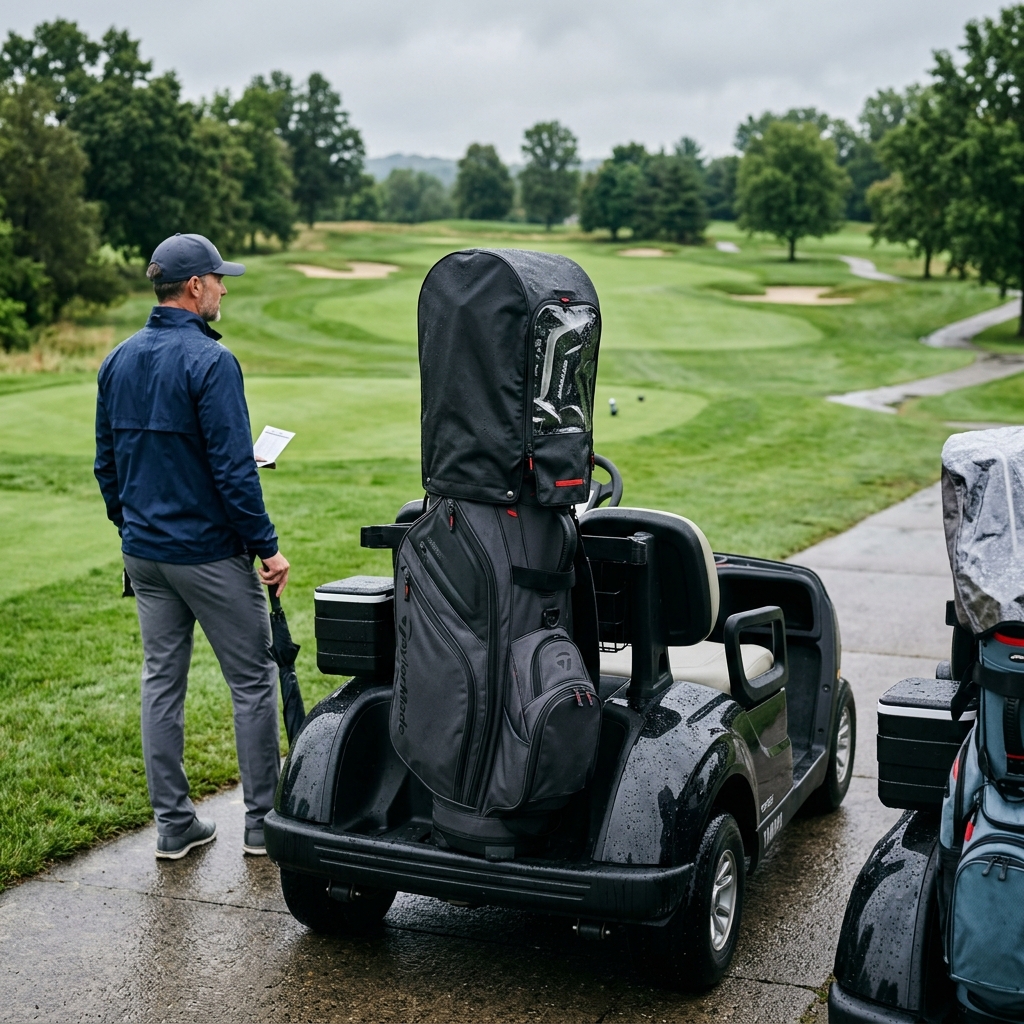
Choose a golf bag rain cover by the area you need to protect and how you will reach your clubs in rain. A hood covers the top opening; a larger cover may protect more of the bag but can make pockets harder to access. Check the exact attachment and dimensions. “Fits most bags” should lead to a fitting check, not an assumption that the cover will seal every bag.
Link disclosure: This guide links directly to manufacturer and retailer information. No commission is assumed from these links.
Guide checked: 8 September 2026. This article uses the linked manufacturer and retailer information. We have not carried out hands-on product testing. Confirm the exact specification and current offer before buying.
| Option | Main use | Check carefully |
|---|---|---|
| Original matching hood | Cover the bag’s top with its intended attachment | Exact bag model and replacement compatibility |
| Universal-style rain hood | Replace or supplement a missing top cover | Opening size, elastic and fastening route |
| Larger bag cover | Shelter more of the body on a trolley | Pocket access and clearance around wheels |
| Weather-focused bag | Built-in fabric and closure protection | What the manufacturer includes and excludes |
Table of Contents
Find out what came with your bag
Check the bag’s pockets and original contents before ordering a replacement. A hood may be stored in a compartment you rarely open. If it is missing or damaged, identify the exact bag model and generation and ask whether a matching replacement is available. A familiar brand logo does not establish that another model’s press studs or zip will line up.
Inspect the attachment points on the bag itself. Replacing a hood will not solve a torn fixing point or a damaged top opening. Ask the manufacturer or retailer about the appropriate repair or replacement part if the problem is in the bag. That avoids buying a cover which has nothing secure to attach to.
Masters BA05B: a hood to check for fit
Masters lists the Clear Rain Hood with Zip BA05B with an elasticated fit and zipped club access. It is a top-cover example, not evidence that the whole bag becomes waterproof. The manufacturer’s “most bags” description still requires checking against your top shape and strap arrangement.
The linked Masters page is a trade-information destination, not an assumed consumer checkout. Use the product code when asking a retailer about the exact item. Try the fit with clubs and headcovers in place; an empty bag opening can give a misleading impression of clearance.
Read the product details for Masters Clear Rain Hood with Zip BA05B at Masters Golf
Players S4 StaDry: understand the bag’s own protection
Titleist describes StaDry construction and seam-sealed zippers on the current Players S4 StaDry. That is a reason to read the model-specific care and protection details, particularly if you are deciding between an accessory and a replacement bag.
Do not treat a weather-focused construction as permission to leave wet equipment packed away. Check the hood, openings and any valuables storage as a complete system. A separate protective pouch can still be useful for items you cannot risk getting wet, depending on the manufacturer’s stated coverage.
Read the product details for Titleist Players S4 StaDry stand bag at Titleist
Make a club-access test before the first wet round
Fit the cover at home and remove several clubs you commonly use. Notice how far the opening needs to be exposed and whether a headcover catches the zip. Check that you can close it again without forcing the fabric across a clubhead. Practising this once is easier than learning the attachment in wind beside the first tee.
If you use a trolley, test with the bag mounted and the upper strap fastened. Confirm that the cover does not interfere with the handle, brake, wheels or moving parts. Keep hanging material and loose cords away from these areas. Follow the trolley and cover instructions rather than inventing an attachment around convenient-looking components.
Think about pockets as well as clubheads
Make a short list of items you need during a wet round: a dry glove, balls, waterproof clothing and something to record the score. Put them where you can reach them without removing the entire cover. A design that protects a large area may still be inconvenient if it forces repeated exposure of everything underneath.
Separate wet towels and used clothing from items you want to keep dry. Avoid packing damp fabric around electronics or leather accessories. A cover cannot correct a poor packing routine, and water already inside the bag still needs to be removed. Keep the storage plan simple enough to use when you are concentrating on the round.
Dry and store the system properly
After play, open the bag and cover and follow their care instructions. Allow the equipment to dry before storing it closed. Check the cover for tears, worn elastic or damaged zips, particularly after it has caught on a club or trolley. Addressing a small problem before the next round is more useful than discovering it in another shower.
Our push-trolley bag guide covers mounting and access. Choose a rain cover that fits securely, opens usefully and can be dried and packed away without difficulty. The most extensive coverage on a product photograph is not necessarily the most practical protection in use.