
Last updated:
On a hilly course, the right golf trolley needs to be manageable going downhill and stopping as well as climbing. A motor helps move the load, but an electric label alone does not identify downhill speed control or a parking brake. Start with the steep sections and stopping places on your usual route, then ask for a demonstration of the exact trolley with a properly fitted bag.
Link disclosure: The manufacturer and support links in this guide are direct information sources. No commission is assumed from them.
Guide checked: 8 September 2026. This article uses the linked manufacturer documentation. We have not carried out hands-on product testing. Check the exact model and current buying terms before ordering.
| Question | What to check | Why it matters |
|---|---|---|
| Climbing | Motor assistance or manageable pushing effort | The load still needs steering |
| Descending | The exact downhill-control system | Motorised does not automatically mean controlled descent |
| Stopping | Parking brake and suitable stopping position | Speed control and a parking brake do different jobs |
| Uneven ground | Bag mounting and model instructions | A brake does not establish stability on every slope |
Table of Contents
Distinguish assistance from downhill control
Ask the retailer to identify three things separately: how the trolley moves uphill, how it regulates travel downhill and how it is held when stationary. If the answer is simply that it is electric, the important questions remain open. Product families often include several control arrangements, so write down the full model name and generation rather than comparing a brand name with a different brand name.
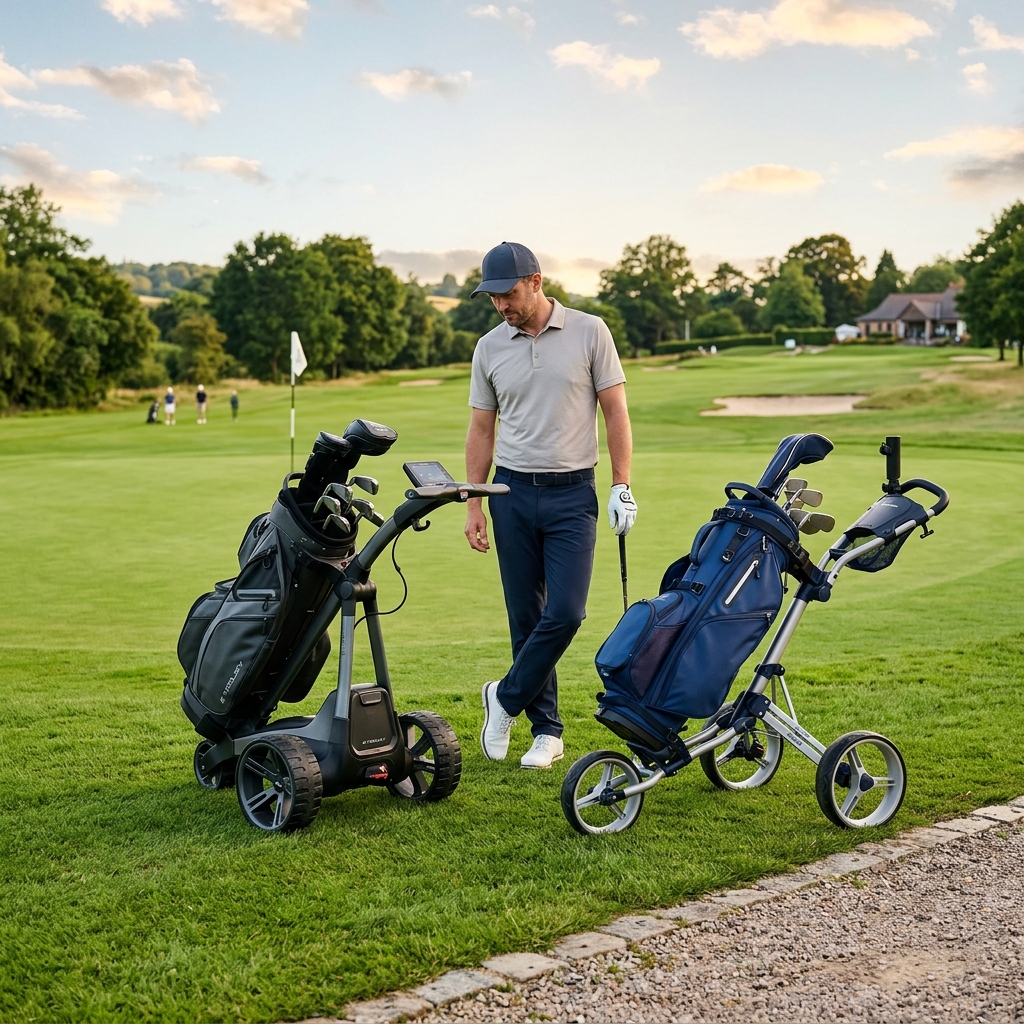
For a documented example, Motocaddy describes the M1 DHC Electric Trolley with automatic downhill speed regulation and an electronic parking brake. Those are specific features of the identified DHC model. They should not be transferred to the ordinary M1, a remote trolley or a later release without checking its own specification. We have not tested the model on a gradient.
Demonstrate the controls before buying
Arrange a demonstration in an appropriate area following the manufacturer’s instructions. Practise starting slowly, stopping, changing speed and identifying the parking-brake state. The useful outcome is understanding what the controls do without hesitation. An unfamiliar brake sequence is something to learn before the first busy round, not while trying to manage a loaded trolley on a descent.
Ask the demonstrator to explain what happens when power is unavailable and how the trolley is moved manually. Use the manual for the exact model for operating limits and procedures. Do not rely on an older internet video that happens to show a similar handle. If the controls or handling do not suit you, a different model may be a better purchase even with fewer advertised extras.
Fit the loaded bag as part of the system
Take your own bag to the demonstration if possible. Secure it as instructed and check that the supports, straps and base make proper contact. Load the pockets as you ordinarily would, rather than assessing an empty bag that changes shape when full. Look for access to the items you need without repeatedly loosening the straps or shifting the load.
A parking brake should not be treated as proof that a trolley cannot tip, slide or move on every surface. Choose suitable stopping places and follow the course’s trolley routes and restrictions. Ask about any model-specific anti-tip accessory, its compatibility and whether it is included. Buying an accessory solely because it fits the brand can leave the actual configuration unresolved.
Compare push and electric options honestly
A push trolley may remain a reasonable option if you are comfortable managing its loaded weight on your course. Include the return climb and the final few holes in that judgement. If an electric model is available to hire, one ordinary round can help you assess the routine more meaningfully than pushing an empty showroom display across a level floor.
Consider transport as well as play. Lift and fold the trolley using the intended method, and measure the space in your car with the other equipment present. The easier device on a fairway may be less convenient to load at home. Our electric versus push trolley guide covers that broader ownership choice.
Choose battery capacity and support for your routine
Tell the seller how many holes you intend to play and describe the terrain, usual load and storage arrangements. Ask which battery option is supplied and what conditions apply to the maker’s endurance claim. A headline hole count is a specification to investigate, not an independent promise that every golfer will achieve it with an ageing battery on every course.
Include service access, compatible replacement parts and the complete delivered configuration when comparing offers. Choose the trolley whose controls you understand, whose bag fit is secure and whose handling suits the actual route. On hilly courses, a clear demonstration of those ordinary tasks is more valuable than selecting the model with the largest feature count.